All the classics, hundreds of handcrafted puzzles, and infinite reasoning-powered puzzles generated from real intellectual frameworks.
A new themed puzzle every week. A new question every day.
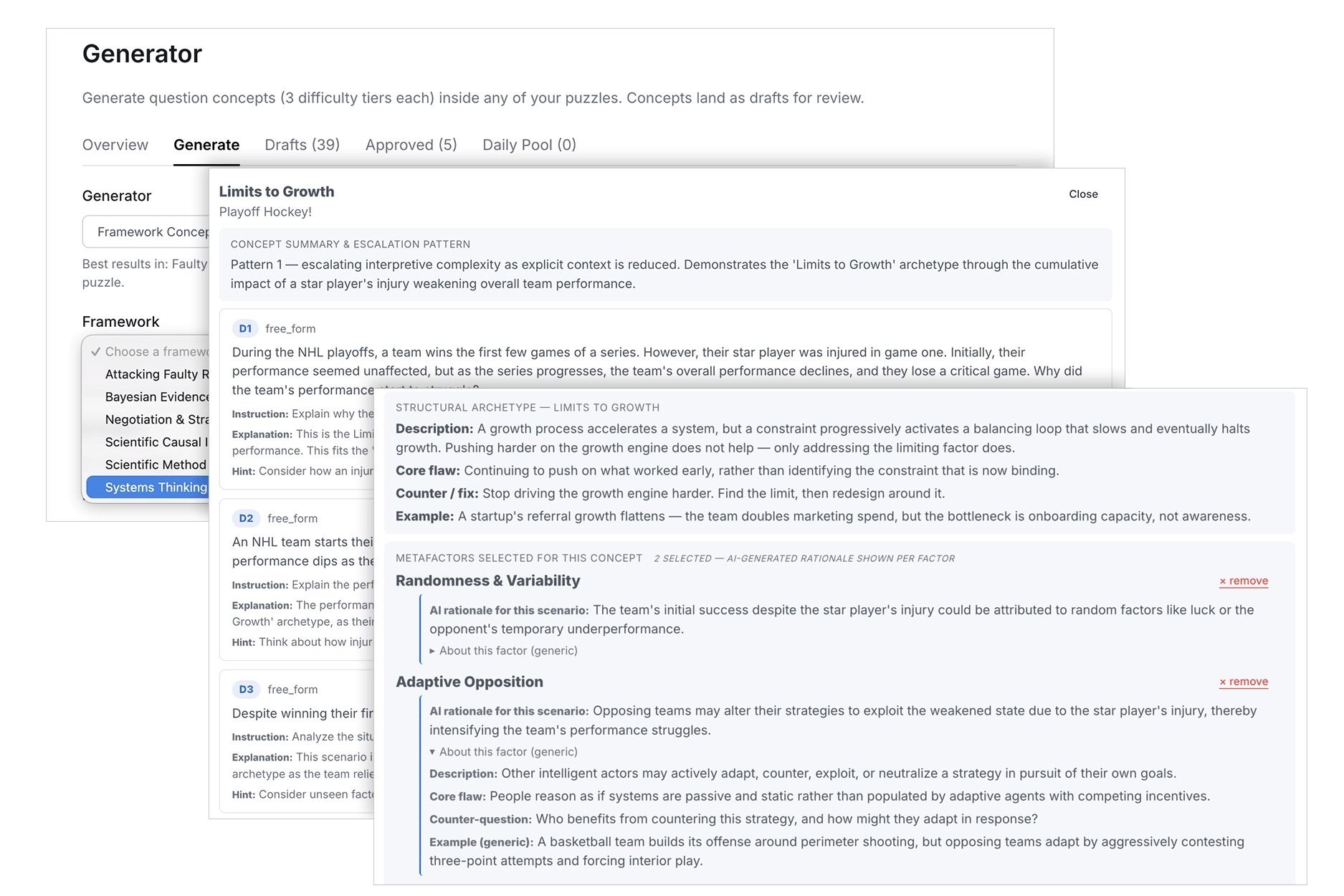
Every week we publish a fresh puzzle built around a single theme — a story, a situation, built on one (or multiple) reasoning-powered frameworks.
And more, every week, as the author community grows
Beyond the weekly puzzle, Riddlewords is being built as an authoring platform. As our creator community grows, they publish puzzles too — classic and reasoning-powered, themed or freestanding — broadening the library on a steady cadence.
Meet the communityThree tiers. Same scenario, escalating challenge.
Every reasoning-powered question exists at three difficulty tiers. The story, the context, and the canonical answer stay the same. What changes is how the question is asked, how many rules are in play at once, and how strictly your answer is scored.
It's the same skill, climbed three rungs at a time — so you can build pattern recognition at Tier 1 and stress-test it at Tier 3 without ever leaving the scenario.
Recognize
Plain reading level. The question points clearly at the rule being tested. Scoring is generous — partial answers and imprecise wording still earn meaningful credit.
Goal: learn to spot the pattern.
Apply
Same scenario, harder question. The wording tightens, more is left implicit, and the rule has to be picked out without a clean signpost. Scoring tightens with it — specificity starts to matter.
Goal: use the rule, not just recognize it.
Synthesize
The same scenario at its most demanding. Multiple rules in play at once, no obvious signpost, and strict scoring across every axis. Partial credit only for genuinely complete answers.
Goal: combine rules under pressure.
Browse every puzzle category
Each category exercises a different mode of reasoning. Try a sample puzzle from any of them.
Reasoning-powered categories
Generated from real intellectual frameworks — each puzzle maps to specific reasoning rules and is scored against them.
Systems Thinking
Diagnose real-world situations using systems archetypes, feedback loops, and structural thinking
Try: Event or Pattern? →Classic puzzle categories
The canon of puzzle traditions — riddles, logic puzzles, paradoxes, lateral thinking, and more.
Scientific Process
Analyze scientific reasoning, experimental design, evidence quality, and methodological rigor.
Causal Diagnosis
Analyze causal claims, confounders, and evidence quality.
Negotiation Analysis
Analyze leverage, incentives, threats, and commitments in strategic interactions.
Evidence Revision
Update beliefs by weighing priors, reliability, selection effects, and rival explanations.
Riddle
Classic riddles with clever wordplay or lateral thinking
Probability Reasoning
Counter-intuitive probability and chance problems
Try: Probability Reasoning →Lateral Thinking
Find non-obvious but credible ideas by reframing the prompt
Try: Lateral Thinking →Emergent Thinking
Combine multiple elements into a system greater than the sum of its parts
Try: Better Together →Ready to solve?
Sign up and start playing — the weekly puzzle, the classics, every tier.