Infinite Ways to Play & Think
Endlessly generated puzzles built from real-world reasoning systems and intellectual frameworks.
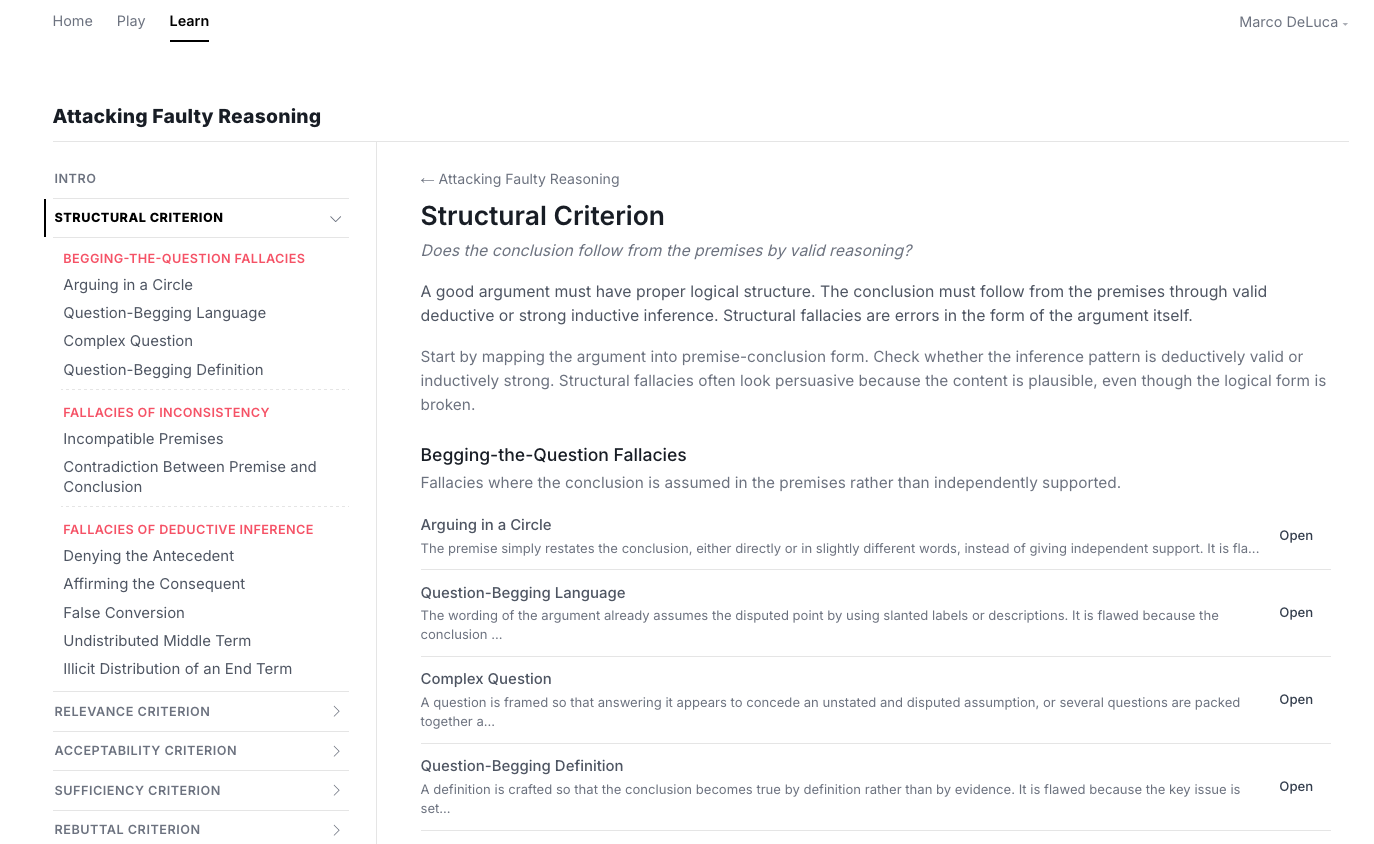

Attacking Faulty Reasoning
Based on T. Edward Damer's taxonomy of logical fallacies. Every fallacy is classified under the criterion of a good argument it violates. Puzzles test whether you can identify which criterion has been broken — not just name the fallacy from a list.
- Structural — Is the argument logically valid in form?
- Relevance — Are the premises relevant to the conclusion?
- Acceptability — Are the premises trustworthy and unambiguous?
- Sufficiency — Is the evidence enough to support the conclusion?
- Rebuttal — Does it address counterarguments fairly?
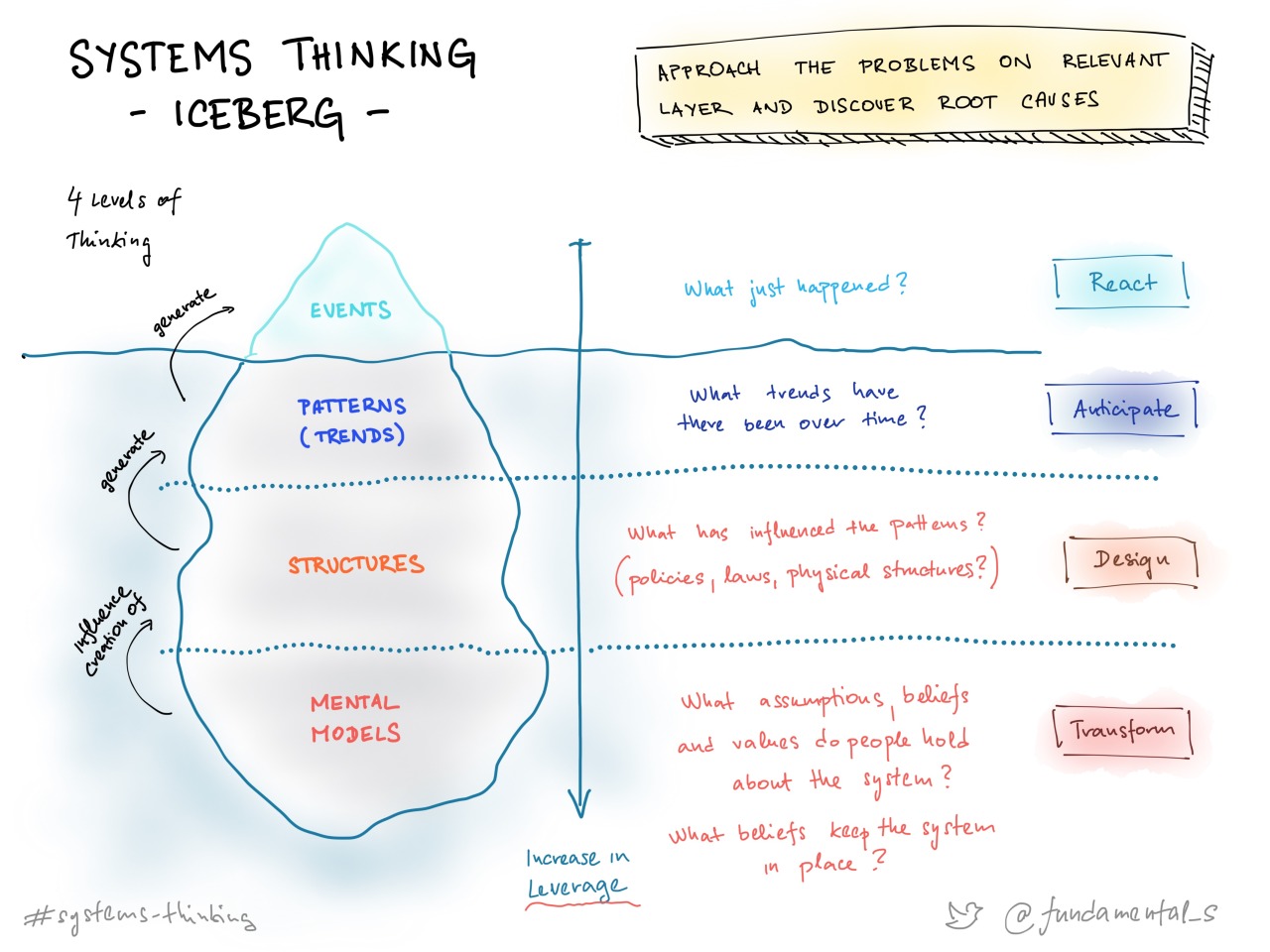
Systems Thinking
Based on the work of Donella Meadows, Peter Senge, Jay Forrester and more.
Puzzles that train you to see the structure behind the symptoms. Players read real-world scenarios and identify which structural pattern — feedback loops, delays, shifting burdens, eroding goals — best explains what's happening.
- Scored on 4 axes including Structural Framing — event-level thinking earns zero even if the rule name is correct
- Strong answers distinguish between confusable patterns and name the diagnostic question that separates them
- Scenarios drawn from business, healthcare, policy, and everyday life

Bayesian Evidence Updating
Drawing on Thomas Bayes, Richard Jeffrey, Daniel Kahneman, and Gerd Gigerenzer. Trains players to update beliefs in proportion to evidence — not to anchor on a first impression, and not to overweight whatever data showed up most recently.
- Base rates & priors — what was the starting probability before the new evidence?
- Signal quality — is this evidence reliable, or weaker than it looks?
- Independence — are these "two pieces of evidence" actually one, double-counted?
- Selection effects — is the data filtered in ways that bias what reaches you?
- Competing hypotheses — does this evidence actually distinguish between rival explanations, or fit them all?
Scientific Causal Inference
Drawing on Judea Pearl, Karl Popper, and Austin Bradford Hill, and more. Separating correlation from causation isn't a one-line lesson — it's a discipline.
Puzzles ask players to evaluate evidence for causal claims: what confounders could explain the same pattern, what interventions would actually test the hypothesis, and whether the data supports the strength of the conclusion being drawn.
- Confounders — what third variable might explain both X and Y?
- Intervention vs. observation — is this a true experiment, or just observed association?
- Reverse causation — could Y be causing X instead?
- Selection & survivorship — are missing cases distorting what you see?
- Strength of inference — does the evidence support a causal claim, or only a weaker associational one?


Scientific Method
Drawing on Francis Bacon, John Stuart Mill, Karl Popper, Ronald A. Fisher, and Robert K. Merton, and more. How reliable empirical knowledge is actually produced — and the specific failures that distort it at each stage.
Puzzles work through the full arc: observation, hypothesis formation, experimentation, analysis, conclusion. Each stage has its own characteristic mistakes, and players learn to spot which stage of the method is being violated.
- Weak observation — sampling bias, vague measurement, observer effects
- Poor controls — confounded conditions, no proper comparison group
- Invalid inference — conclusion doesn't follow from the data
- Statistical misuse — p-hacking, multiple comparisons, misread effect sizes
- Replication failure — claims that don't hold up when re-tested
Strategy & Negotiation
Drawing on Roger Fisher, William Ury, Thomas Schelling, and Chris Voss, and more — texts like Getting to Yes, The Strategy of Conflict, and Never Split the Difference.
A framework for reasoning about incentives, leverage, signaling, and credible commitments. Puzzles test whether players can read what's actually being communicated — the constraints, the alternatives, the threats that are real and the ones that aren't.
- Hidden constraints — what is the other side actually unable to do, regardless of what they say?
- BATNA (Best Alternative To a Negotiated Agreement) & leverage — who has the better outside option, and how does that shape the deal?
- Credible commitments — is this threat real, or just words?
- Signaling — what information is the move itself meant to communicate?
- Anchoring & framing — how does the way an offer is presented shape what feels reasonable?

MetaFactors
Frameworks teach the lens — a Bayesian update, a structural pattern, a fallacy. MetaFactors teach the orthogonal real-world forces that shape whether the lens fits: chance, timing, strategic adaptation, hidden incentives, partial observability.
A player can correctly identify a fallacy or a Bayesian update and still misread the scenario — because they failed to notice that the outcome was dominated by randomness, that the situation was being shaped by an adaptive opponent, or that the relevant data was never visible in the first place.
Randomness & Variability
Outcomes may be heavily influenced by chance, noise, or probabilistic variation rather than underlying skill, structure, or reasoning quality.
Context & Timing
The success or failure of an action depends heavily on environmental conditions, timing, and the current state of the surrounding system.
Adaptive Opposition
Other intelligent actors may actively adapt, counter, exploit, or neutralize a strategy in pursuit of their own goals.
Agency & Self-Interest
Individuals within systems are adaptive agents pursuing goals under conditions of incomplete information, competing incentives, social pressures, and bounded rationality. Behavior is often driven less by stated values or collective objectives and more by what protects personal interests, preserves status, reduces risk, secures advantage, or aligns with internal mental models of success. Actors may cooperate, compete, conceal information, shift responsibility, resist change, optimize for local rewards, or strategically adapt their behavior in response to pressures within the system.
Information Limits & Hidden Variables
Decisions and interpretations are often constrained by incomplete, delayed, distorted, or unobservable information.

Frameworks → Puzzles → Scoring
- Each framework defines categories, rule groups, and individual rules
- Puzzle questions link to specific framework rules they test
- The Learn section lets you browse the full taxonomy alongside the puzzles
- Bonus scoring axes can reward naming the specific rule
- Frameworks and scoring rubrics are also used to generate new questions with AI
- MetaFactors layer on top — orthogonal scoring axes that reward recognizing the deeper conditions shaping each scenario
Explore the frameworks
Sign up to access the full Learn section and browse every rule in the taxonomy.